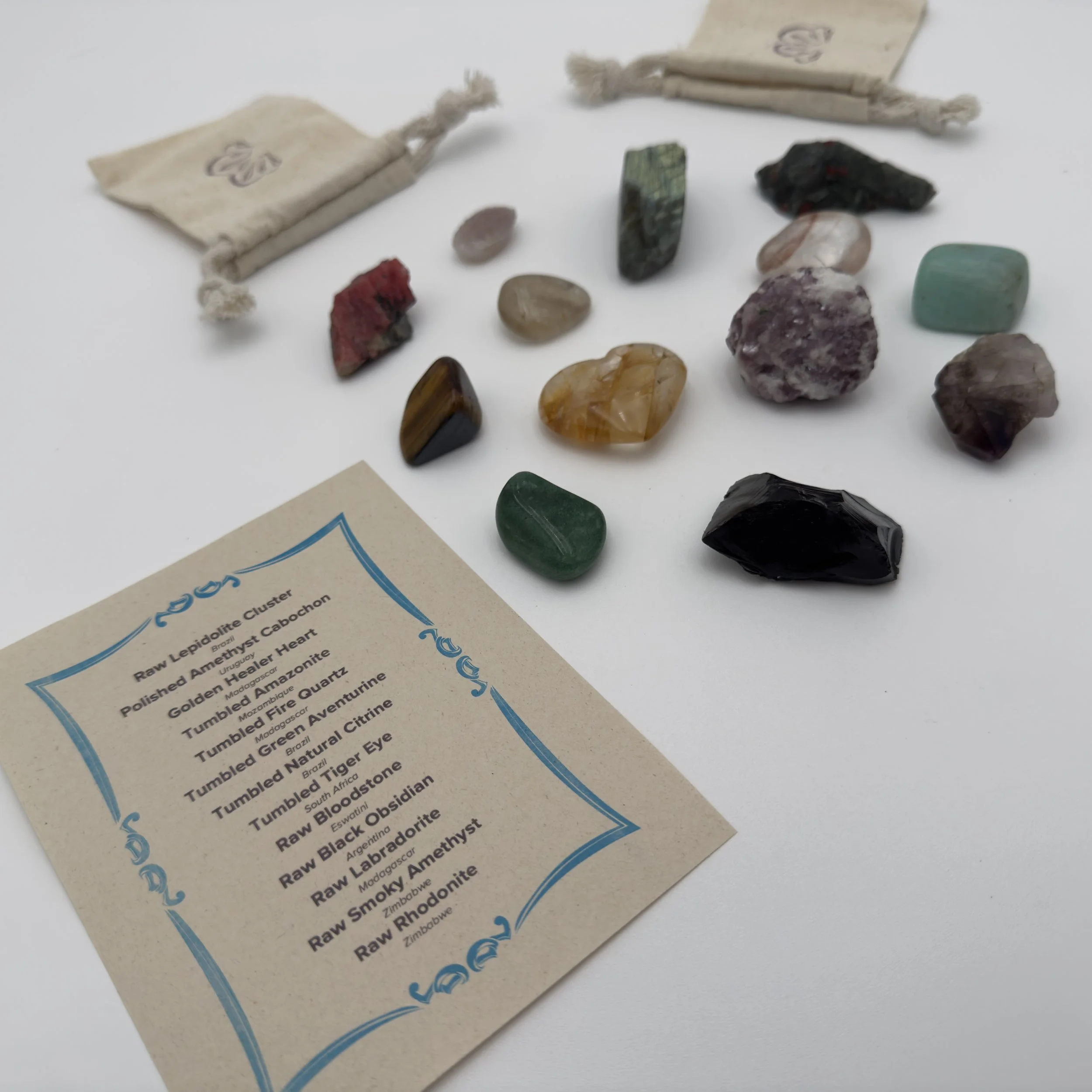
Healing Crystal Guide
& Stone Meanings
Every crystal in our Beyond Ethical™ collection is natural, untreated, and sourced with full transparency. This guide tells you exactly what each stone is, where it comes from, and how people work with it today.
Introduction
Crystals have existed long before humans began naming, categorizing, or attributing meaning to them. They form slowly, often under immense pressure, heat, or time, shaped by geological forces that operate far outside human scales. What draws people to crystals today is not only how they look, but the sense that they carry history, structure, and stability in a world that often feels chaotic.
The crystal market is crowded with conflicting information, exaggerated claims, and simplified narratives that rarely reflect how crystals actually form, where they come from, or what happens to them before they reach the buyer. Many descriptions focus on symbolism or metaphysical interpretation without addressing the physical reality of the stone itself. Others lean heavily on scientific terminology without helping the reader understand why any of it matters.
Here, we take a grounded approach.
Each crystal in this guide is presented as both a natural material and a cultural object. You will learn how it forms, where it typically comes from, what treatments are common, how to identify it, and how it is used in modern spiritual and wellness practices.
Throughout this guide, clarity is prioritized over persuasion. When information is uncertain, that uncertainty is stated. When treatments are common, they are named. When sourcing is complex, it is not simplified for convenience. Crystals are remarkable on their own. They do not require embellishment to be meaningful.
Whether you are new to crystals or have worked with them for years, this guide is intended to serve as a steady reference. One you can return to whenever you want a clearer understanding of what a stone is, where it came from, and how it is typically used today.
How Crystals Are Formed and Sourced
To understand crystals, it helps to start far earlier than the point of sale.
Crystals form when atoms arrange themselves into repeating, ordered structures. This process can occur in a variety of environments: deep underground within cooling magma, in cavities left by volcanic gas bubbles, through slow mineral deposition from water, or under intense pressure during tectonic activity. The conditions under which a crystal forms directly influence its shape, clarity, color, and stability.
Some crystals grow freely in open spaces, developing well-defined points or clusters. Others form compactly within rock, later cut or separated during extraction. These differences are not cosmetic. They reflect the geological history of the material and help explain why no two pieces are ever truly identical.
Formation Environments
Most crystals fall into a few broad formation categories. Igneous formation occurs when magma cools, either below the earth's surface or after a volcanic eruption. Crystals that form slowly, deep underground, tend to develop larger, more defined structures. Those that cool quickly at the surface tend to be finer-grained.
Hydrothermal formation involves hot, mineral-rich water moving through cracks and cavities in rock. As the water cools, minerals crystallize out of solution. Many well-known crystals, including quartz varieties, amethyst, and fluorite, form this way.
Sedimentary and metamorphic environments produce their own distinct crystal types. Pressure, heat, and chemical interaction over time can transform existing minerals into new crystalline structures entirely different from their original form.
Treatments and Market Realities
Not all crystals reach the market in their natural state. Heat treatment, irradiation, dyeing, stabilization, and surface coatings are all used to enhance color, improve durability, or create visual effects that increase commercial appeal. Some treatments are subtle and difficult to detect without laboratory testing. Others are obvious once you know what to look for.
Treatments are not inherently good or bad, but they do change the nature of the material. In this guide, treatments are discussed openly, including how common they are and why they are used. Understanding this context allows you to make informed decisions and avoid common points of confusion, especially where natural and treated materials are frequently mislabeled or sold interchangeably.
Crystal Index